
(This is a living document, subject to change. The footer contains the date originally published as well as the date of last update.)
Introduction
I went through my church's requirements and was baptized as a child. It was not until the latter part of high school that I realized I had never really been born again. A teacher started teaching christian ‘apologetics’. Not only was I convinced the claims of Jesus were true but the importance of ‘truth’ itself was instilled in me. I became a tenacious critical thinker and seeker of truth.
I developed an insatiable appetite for the Bible. I recall thinking that the account of the New Testament church, as recorded in the book of Acts, was the most exciting story that I had ever read. I learned that while much of what I had been taught growing up was true, quite a bit was mere tradition.
My certificate of ordination is dated just a few days after my 23rd birthday. I was part of a large church that was part of a large denomination. I was living out west for several years, the only time I’ve lived outside of my home state of Georgia. I remember being drilled on my theology by a large room-full of older men. With my well-worn Bible in hand, I was a little nervous but confident that it was the Lord that was calling me to Christian ministry. They were impressed by my knowledge of the New Testament, as well as my honesty about theological issues that I had not yet come to a conclusion on.
Many years and hardships later I was sitting at a small cafe with a missionary that I had befriended at church. Church and ministry had already become a frequent, spirited discussion with us. He handed me a book that he had brought for me. It was ‘Organic Church: Growing Faith Where Life Happens’ by Neil Cole. Wanting to be considerate, I agreed to look it over, imagining I would return it shortly. I had difficulty putting that book down. I have wanted to be a part of a movement like that ever since, not because it seemed like a good idea or method but because it is biblical. It is much closer to the New Testament church described in the book of Acts than any I had encountered and I had encountered many churches by this time.
About a month ago that same missionary came to visit me at my new home. I said to him, “I’ve been desiring the ‘more New Testament church experience’ described in ‘Organic Church’ for over a decade now”. He thought about it and said that it had been at least 15 years. That was disheartening when I thought about it the next day. Yet our timing is not God’s timing. I have learned much more since that time and am convinced that the Lord has led me into many additional, vital truths—from other books, solid commentators and teachers and diligent prayer—all deeply rooted in scripture.
Cole is not alone in this revelation and the concept is not without success. His book was born out of experience. It records 10 churches starting in the first year, 18 in the second and 52 in the next. He reports 106 starts in 2002 and about 200 the year after. He estimates about 400 churches were started in 2004, then they basically lost track but at the time he’s writing Organic Church, he estimates close to 800 churches in 32 states and 23 nations in only six years.
Neither is it a passing fad. In March of 2026 my wife and I attended a Microchurch conference. I had no idea what to expect but we arrived to find over 500 participants from over 30 states and several countries.
Top among the other books I’ve read is ‘Letters to the Church’ by Francis Chan. Chan documents his profound realizations as he founded a church which grew into a megachurch. He eventually resigned and now leads a simple church movement called ‘We Are Church’ with multiple churches around the country.
Purpose
The New Testament describes a church characterized by simple gatherings, the active participation of every member, shepherding elders, serving deacons, and the multiplication of all of these. The contemporary church has departed significantly from this biblical pattern, diminishing its effectiveness in advancing the Kingdom of God. Recovering these New Testament principles and practices offers a pathway toward restoring the church's biblical character and effectiveness in fulfilling its mission.
I am not proposing something new simply for the sake of innovation. It will only appear new precisely because it is ancient.
However, it’s important to note that I am not writing a treatise on reforming the contemporary church—to convince existing churches that they’re doing everything wrong. I am writing to explain biblical convictions and practices that will guide a fellowship that I envision establishing with the primary motive of ‘proclaiming Christ where He is not yet known’.
With that said, considering most of us in the US have some church or religious experience, I find it only fair to outline what I propose, contrasting it to existing churches, so that prospective members will know exactly what they are getting into.
Therefore, I will attempt to provide in this document a biblically grounded explanation and defense of a proposed fellowship that seeks to recover the character, leadership, participation, and disciple-making practices of the New Testament church.
My heart’s passionate desire is that the Lord will so bless it that it becomes a ‘multiplication movement’ and that all involved will remain in humble submission to Him, always mindful that, “Unless the Lord builds the house, those who build it labor in vain.” (Psalm 127:1)
We must begin with a careful look at what the word ‘church’ meant to the earliest Christians.
The Ekklēsia
The Greek word is ekklēsia (pronounced ek-klay-see’-ah). Its simplest meaning is: a gathering of citizens called out from their homes into some public place, an assembly. The Hebrew words translated to ekklēsia often referred to the gathered ‘covenant’ people so when Jesus said in Matthew 16:18, “I will build my ekklēsia”, the Apostles, as well as later Jewish readers would have known exactly what he meant. When Jesus uses ‘my’ just before ekklēsia, He’s literally claiming ownership of the covenant people of God. It was an audacious, even shocking claim to any Jew of that era.
It is when a person believes the claims of Jesus and commits to turn from a self-directed life to be a follower of Jesus that they are born again and become a member of the ‘my ekklēsia’ Jesus refers to—His church. For a more complete understanding of the rebirth, please see ‘The Good News’.
Paul, addressing the Elders of the Ephesian church, again emphasizes and clarifies this ownership of the new covenant people.
Pay careful attention to yourselves and to all the flock, in which the Holy Spirit has made you overseers, to care for the church of God, which he obtained with his own blood. (Acts 20:28)
This is the first occurrence of several in the New Testament of the phrase ‘Church of God’. With the well established sense of ‘called out ones’ it adds the sense of called out by and unto God. As He called out the people of Israel to be separate and devoted to Him under the Old Covenant, now he is calling out a people to be separate and devoted to Him under a New Covenant.
The following verse brings this idea to a beautiful completion:
But you are a chosen race, a royal priesthood, a holy nation, a people for his own possession, that you may proclaim the excellencies of him who called you out of darkness into his marvelous light. Once you were not a people, but now you are God's people; once you had not received mercy, but now you have received mercy. (I Peter 2:9)
It is clear that the church is composed of all those who have been born again. It is at the moment of rebirth that one passes from ‘darkness into his marvelous light’, to become ‘God’s people’ who have ‘received mercy’. Consequently, it is not your church, our church, your Pastor’s church or your denomination’s church. The ekklēsia, the people, belong to God. It is Jesus’s church, the church of God.
The word ‘church’ is also used to describe individual locations and is used in plural form to describe ‘churches’ of certain regions. However, it would also be correct to translate the word to ‘assembly’ or ‘congregation’ as is done in Acts 19:32. It is still therefore, referring to the people. So there is the global church—everyone everywhere who has been born again—and there are local congregations of that one church in various places.
To the church of God that is in Corinth, to those sanctified in Christ Jesus, called to be saints together with all those who in every place call upon the name of our Lord Jesus Christ, both their Lord and ours: (I Corinthians 1:2)
These things are so obvious from the scriptures that you may not think it necessary to explain. However, think about how the word ‘church’ is used in our current culture. It is used as a place, the church building; as an activity, to ‘have’ church and to divide the church into different categories—Protestant / Catholic / Orthodox—and Protestants into hundreds of denominations based on different theological distinctives. Now, I’m not saying this is all evil. There is a long complicated history behind how it all developed, most with good intent. However, I am saying that it did develop after the time described in the Bible.
I am convinced that God now wants to call out a people to return to the ancient biblical understanding of church—one that will be new and foreign to our culture.
So now if someone asks you, “Where do you go to Church?”, perhaps, since you already have a better understanding of the word, you should appear perplexed. Practice the look and tilting your head just a bit and reply, “What do you mean by ‘go to Church’?” Practice pronouncing ekklēsia (pronounced ek-klay-see’-ah) and explaining the meaning. What a great way to begin a spiritual conversation!
Now, if the church of today is so very different from the New Testament church, how did that happen? Much has been a gradual drift. It’s worth our time to take a brief look.
A Little History
In the Old Testament, God sent His Spirit to the Prophets to communicate His messages to the Israelites. A special order of Priests descended from Aaron, cared for the temple and administered the sacrificial system. Yet when Jesus came and became the ultimate and final sacrifice for sins, the sacrifice of animals was no longer necessary. When He was crucified, the thick veil in the temple that isolated the most holy place of the Ark of the Covenant was rent in two from the top to the bottom. The presence of God would no longer be limited. Jesus implemented a completely new covenant, literally offering all of mankind friendship with the living God. Those who recognize this good news and change their allegiance to Jesus become themselves ‘temples of the Holy Spirit’. The separate class of Priests that administered the old covenant practices was no longer needed.
Consequently, the New Testament church had two simple administrative offices, Elder and Deacon. The Elders exercised authority and ‘shepherded the flock’. The Deacons were more of a service role and were assistants to the Elders (We will look into these scriptures later in the ‘Leadership’ section).
As early as the second century we find writings from church leaders that describe a third office. It’s understandable that with the exponential growth of Christianity, they were simply looking for the best way to manage things. Later, after initial persecution of Christians by Rome, Christianity became legal and even later it became the official religion of the Roman empire. As this unfolded, a distinct ‘clergy’, separate from the ordinary believers or ‘laity’ (‘plebs’ at that time) emerged. The difference between leaders and other Christians was becoming not merely one of function but one of status.
The physical setting was changing during this same period. Growing communities of believers began adapting larger spaces for congregational use. By around A.D. 300, there is also evidence for buildings constructed specifically for Christian worship. The gathering of the church was therefore gradually becoming associated with a dedicated place. This setting was more conducive to increasingly formal leadership and worship than the smaller household assemblies reflected throughout the New Testament.
With the clergy/laity divide already firmly in place, Greek gradually gave way to Latin which became the sacred language of Western Christian Scripture, theology and worship. In medieval Western Europe, literacy itself was heavily concentrated among clergy and other educated elites. Consequently, an ordinary Christian increasingly depended upon clergy to read Scripture, interpret it and provide instruction. We of course eventually find huge, ornate cathedrals with incredibly formal worship and ceremony that are foreign to the church described in the New Testament.
Though significant challenges to the clergy/laity divide occurred during the long and complex history since Jesus and many modern authors and commentators challenge it, it survives to some extent in most all expressions of Christianity today.
After my youngest son made a profession of faith in Jesus, I wanted to baptize him. I had tremendous respect for the Pastor of the church I was attending. He prepared excellent, engaging sermons for each Sunday. They were always biblically sound. I went to this Pastor to speak to him about baptizing my son. He explained that the ordinance of baptism was normally administered by an ordained minister. I said something like, “Great! I am one of those.” I explained my calling and ordination. He conceded and allowed me to use the facility to do the baptism and invite family to attend at a time when the sanctuary was not being used, just not during a regular service when baptisms normally occurred. I graciously accepted his offer at the time but don’t recall him supporting his decision with any scripture. Though I didn’t really understand why at the time, I just had this feeling that something wasn’t quite right.
It’s clearly a human tendency to maintain control through structure. The larger our institutions become, the more complex the structure. However, if we truly do have the Spirit, why do we feel the need to control? Do we not trust Him? We can return to the more simple way. It won’t be complicated. To the contrary, it will be an extraordinary simplification. It will not be easy either. The clergy/laity divide is deeply ingrained and must be decisively abolished. Therefore the responsibility of ministry must shift from professional staff to the congregation. Come and imagine with me what that would look like and how it would work in our communities today, perhaps in your community.
Mission

Proclamation by All
| Traditional Church | Proposed | |
|---|---|---|
| Mission | Attracting people through various programs and teaching biblical principles for successful, meaningful life and faith. | Proclamation of the gospel by every member for the rebirth of all who will repent and believe. |
One of the inevitable results of the clergy/laity divide is that the regular members without the formal education to be ‘clergy’ begin to think that they are not qualified to proclaim the simple good news of the kingdom. This is why one of the main practices in the modern church is to invite nonbelievers to church so they can hear the clergy teach and preach and perhaps believe. This happens in varying degrees across a plethora of Christian traditions. However, when we examine the scriptures, we see that this is certainly not the case with the New Testament Christians. Jesus’s words and many other scriptures command that we all proclaim the good news. Indeed, it is the mission of the church.
And Jesus came and said to them, “All authority in heaven and on earth has been given to me. Go therefore and make disciples of all nations, baptizing them in the name of the Father and of the Son and of the Holy Spirit, teaching them to observe all that I have commanded you. And behold, I am with you always, to the end of the age.” (Matthew 28:18-20)
Note that the following verses are in a letter that is addressed to the entire regional church that Paul is sending the letter to:
Paul, an apostle of Christ Jesus by the will of God, and Timothy our brother, To the church of God that is at Corinth, with all the saints who are in the whole of Achaia: (II Corinthians 1:1)
Therefore, if anyone is in Christ, he is a new creation. The old has passed away; behold, the new has come. All this is from God, who through Christ reconciled us to himself and gave us the ministry of reconciliation; that is, in Christ God was reconciling the world to himself, not counting their trespasses against them, and entrusting to us the message of reconciliation. Therefore, we are ambassadors for Christ, God making his appeal through us. We implore you on behalf of Christ, be reconciled to God. For our sake he made him to be sin who knew no sin, so that in him we might become the righteousness of God. (II Corinthians 5:17-21, emphasis mine)
Meditate on that last verse for a moment. It’s really shocking. When a person experiences rebirth, the cleansing of sin is so complete that they ‘become the righteousness of God’! Born again Christians are fully qualified to tell others what they have experienced—no formal education required. You’ll learn and get better as you go. Think of it as on-the-job-training.
Our proclamation must be thorough and patient with the end goal of rebirth. Our faith must be defended with ‘gentleness and respect’ (I Peter 3:15) and never harshness and disrespect. This will be the main mission of our church as it was in the New Testament. The motive must always be love.
Multiplication vs Addition
| Traditional Church | Proposed | |
|---|---|---|
| Growth | Addition: dynamic programs, music, teaching and member invitation attract visitors | Multiplication: Every member becomes a disciple that makes disciples |
Perhaps almost as important as understanding that ‘proclamation by all’ is a command directly from Jesus, is understanding the principle of multiplication that He set into motion. You may not think that you could participate in bringing a very large number of people to faith in Jesus. Perhaps you could envision just a few. However, this is key: You should endeavor to show those new believers that they also must be obedient to proclaim the good news and teach others to do so, continuing the cycle of ‘exponential growth’ started by Jesus.
You may have heard some illustrations of amazing numbers of ‘exponential growth’ by multiplication. My favorite is using a checkerboard. There are 64 squares. If you place one penny on the first square, two on the second and four on the third, continuing to double the number all the way up to the 64th square, you would end up with a literal mountain of pennies. In dollars it would equal $184,467,440,737,095,516.15. You would read that number like this: 184 quadrillion, 467 trillion, 440 billion, 737 million, 95 thousand, 516 dollars and 15 cents. That number of dollars would pay off the US national debt (about $36 trillion at the time of this writing) 5,124 times.
Of course that huge number exceeds the global population and we know that not everyone who hears the proclamation will accept it. However, if you fully grasp this concept, you realize that you and those you initially bring to Jesus will eventually amount to more than the largest mega church. Rest assured this truth upsets, perhaps even terrifies the forces of evil. Expect stiff resistance.
For a more complete explanation, please see the message entitled: Our Mission.
Angel Groups
| Traditional Church | Proposed | |
|---|---|---|
| Small groups | Large congregation is gathered and solicited to participate in small groups | Angel Groups multiply until there are enough to begin a larger Oikos Group |
In the New Testament, the term Angel (ang'-el-os in Greek) simply means ‘messenger’. The first announcement of the good news about Jesus was from the angels to the shepherds (Luke 2:9-14). Angel Groups are where seekers can come to hear that same good news and come to understand its significance for their lives. Angelos can also refer to a human messenger.
As the early disciples spread out to proclaim the gospel from ‘house to house’, I’m confident it sometimes required more than a single visit and likely others might be brought in to explain certain aspects more thoroughly. That is basically what I’m calling an Angel Group.
We also have some advantages that the first century Christians did not have. For one, we are greatly blessed with crazy accessibility to scripture. Anyone can download YouVersion for free. It’s a great app! The Bible Project has outstanding videos that can really help one understand each book of the scriptures in context with the rest. As they like to say, “The Bible is one unified story that leads to Jesus”. These two ministries have teamed up to include YouVersion Bible reading programs that include Bible Project videos!
We will incorporate some of these free, useful tools to do the same things the early Christians did—proclaiming the gospel and devoting ourselves to the Apostles teachings:
And every day, in the temple and from house to house, they did not cease teaching and preaching that the Christ is Jesus. (Acts 5:42)
And they devoted themselves to the apostles' teaching ... (Acts 2:42)
Learning

| Traditional Church | Proposed | |
|---|---|---|
| Learning | Direct bible teaching from professional clergy with other teachers using bible-based curriculum and books | Direct bible reading by all in the community with one another. Shepherding Elders give guidance and guard against false teaching. |
Though all will be expected to participate in Angel Groups and it will be our standard practice for evangelism and learning the scripture in community, it will not be the only way. We must remain open to the Spirit’s leading to proclaim the gospel in any way, in any circumstance possible. The Spirit will also lead many to dig into the scriptures beyond regular Angel Group readings. It’s so exciting to follow that inspired curiosity and learn a new truth. It can do anything from changing your entire perspective to setting you free from a life-long bondage, sometimes one that you didn’t even know that you had.
Biological Life Analogy
Neil Cole has noted in his book ‘Organic Church’ that all biological life begins at the molecular level. It is also where all reproduction begins and it develops from the micro to the macro, from the simple to the complex. He explains that it is the same in the Kingdom of God. There are several parables and comparisons in the New Testament that illustrate this. Cole goes on to say:
“There is much discussion these days about church multiplication. This is my passion and life. But no matter how committed we are, we will never see church multiplication if it is all we speak of. Trying to multiply churches is starting at the wrong place. A church is a complex entity with multiple cells. We must go further down microscopically, to the smallest unit of Kingdom life if we want to start the multiplication process.”
“If we cannot multiply churches, we will never see a movement. If we cannot multiply leaders we will never multiply churches. If we cannot multiply disciples, we will never multiply leaders. The way to see a true church multiplication movement is to multiply healthy disciples, then leaders, then churches, and finally movements—in that order”
Cole goes on to simplify the basic elements of church that need to be present in every unit from the smallest gathering of 2-3 to the largest and gives it a tidy acronym that perfectly fits his biology analogy: DNA. He explains that just as in our Creator's biological world, the DNA exists in the smallest unit and is necessary for multiplication, so it is with the church. They are 'Divine Truth', 'Nurturing Relationships' and 'Apostolic Mission'. He gives much supporting scripture and explanations of how they all interact. Then he adds:
"But one constant remains: Divine Truth in the heart is the start of everything. A transformed life, and consequently loving relationships and a life on mission, is the fruit of Divine Truth flooding the heart set free by the powerful atoning work of Jesus that is the starting place for all else. Attempting to start from any other place is not only futile but results in fleshly exercises that yield a life of bondage." (emphasis mine)
Let’s look at how each one of these will operate in our Angel Groups (the micro):
Divine Truth
When Neil says, “Divine Truth flooding the heart set free by the powerful atoning work of Jesus that is the starting place for all else”, he is referring to the rebirth. The good news about Jesus and the call to believe and repent results in a miraculous spiritual rebirth for those that accept it and decisively change their allegiance to Jesus. This is the ultimate truth and the beginning point that enables all divine truth to take root because understanding the teachings of Jesus and the Bible require the Holy Spirit. Understanding the innumerable truths of God’s word is not just a matter of intellectual acceptance. It requires identifying the false beliefs that have been governing your life and replacing them with God’s truth and wisdom. So repentance is a life long process. It is only the ‘initial repentance’ that occurs at the rebirth.
Sadly, the average clergy-dependent church member is fairly illiterate when it comes to knowing and understanding scripture. Consuming the Word of God and meditating on it must become a daily discipline. Reading and learning the Bible together and discussing the passage read will be the main weekly activity in an Angel Group. Groups should pursue reading first the Gospels and then the New Testament, followed by the Old Testament. It should be the goal of every member to eventually read the entire Bible. This should begin a lifetime discipline of reading and studying scripture.

After a genuine rebirth, the normal response is to have a ravenous appetite for God’s Word. Most people realize a miraculous change has occurred in their life and they begin reading the Bible to understand what has happened to them.
Nurturing Relationships
A small group of 2-4 provides an intimate environment of transparency. With the presence and guidance of the Holy Spirit, amazing insights that result in life changing realizations occur. All members should pray for one another and encourage one another in their efforts to advance the Kingdom of God, grow in their relationship with Jesus and strive for holiness. Participants are encouraged to stay in touch during the week through texts or calls. The goal is to ‘do life’ together.
This will be deeply meaningful. Strong, lifelong bonds of friendship will be forged.
Apostolic Mission
All members should be actively praying for, interacting with and encouraging unbelievers to come into the Angel Group. Though many other means may be used to bring people into the kingdom, Angel Groups will be our main method of introducing the gospel to anyone open to considering it. Groups will need to be flexible to shift their reading to the gospel whenever a new seeker enters. Any group that grows from 3 to 4 should be considered ‘pregnant’ and ready to give birth to a new group. There should always be at least one committed, born again believer to host but this is the only qualification. It’s much easier for a group this small to agree on a time and location than it is with a larger group.
Hospitality
I’m writing this from a home my wife, Jenny, and I moved into just a few months ago. We have already begun reaching out to our neighbors to get to know them. That often includes going up to the front door and knocking with a loaf of Jenny’s fresh, homemade sourdough bread in hand. We hope to eventually have some social gatherings of neighbors at our home with the intent of simply getting to know our neighbors and to display the genuine love that exists in our family of believers. Jesus said, “By this all people will know that you are my Disciples, if you have love for one another” (John 13:35). We are also hopeful that spiritual conversations will lead to the beginning of Angel Groups within the neighborhood.
Jenny is definitely gifted in hospitality—me, not so much. It can be a wonderful means to foster relationships within an atmosphere of love and openness. Yet, it’s not the only way. We are all gifted in different ways and even a person like myself, who is considered rather quiet by most standards, can begin conversations to identify those who are open to reading the Bible together.
Service
As we go into our communities, we will inevitably meet people with various needs, both physical and spiritual. We certainly want to be sensitive to those needs and meet them in any way possible. Jesus certainly cared (Luke 12:33, 14:13-14). However, an abundance of gospel scriptures clearly demonstrate that this was not His main mission.
One of the main themes across the Bible is God’s patient, persistent pursuit of us in love to follow Him and submit ourselves to His wisdom. This is for our good. The scriptures are full of principles that help us to flourish. Usually, spiritual or financial poverty is the result of a person or someone closely connected to them not following God’s wisdom. We will use initial contacts and meeting needs as an opportunity to proclaim the gospel to invite that person into the Kingdom of God. Should they accept—believing, repenting and being baptized—we will joyfully receive them. Then, within our community, they can begin to learn of God’s wisdom so that they can begin to follow His principles. In this case, we will be glad to minister to their needs as much as possible. However, should they reject the gospel, they have rejected God’s wisdom and the principles which could free them of both spiritual and financial poverty. Therefore, it would be irresponsible for us to continue expending resources on them, thereby neglecting those within God’s kingdom who may have need of those resources as they grow to maturity.
Service efforts will be led by biblically qualified Deacons.
Oikos Groups

Oikos is the Greek word for house. It is also translated as ‘household’ so also has the connotation of ‘family’. We are open to these groups meeting most anywhere, though it’s likely most will meet in homes.
When there are three or four Angel Groups meeting within an area, it is time to launch a larger gathering. While Angel Groups are open to ‘seekers’, Oikos Groups will consist of those who have made a firm commitment to be a Jesus follower and entered our community of believers through rebirth followed by baptism or by demonstration to an Elder that they are born-again believers and have been scripturally baptized elsewhere.
Why not invite everyone?
You may be thinking, “Now wait Christopher! Don’t we need to be welcoming to everyone!” I hear you. I struggled with this too based on my own tradition and upbringing and we do want to be hospitable and serve those in our community as we have discussed. However, we will do so at the Angel Group level and out in the community through hospitality and service. When one crosses the boundary that takes them ‘out of darkness into his marvelous light’, they become full members in the family of God. This is not a boundary we are creating to exclude people. It is one that reflects existing spiritual reality.
You want to have exclusive time with just your immediate, physical family, right? That is because you share a bond of love with them that is much stronger and deeper than you will ever have with others. There are also family matters that don’t concern those outside of your immediate family that would be inappropriate to discuss with others. So it seems reasonable that this would be the case with our spiritual family as well.
We will not forbid someone from visiting. I Corinthians 14:23-24 mentions ‘If… unbelievers or outsiders enter’. Yet, neither will it be our practice to invite unbelievers into the ‘Ekklesia’. The New Testament practice was for believers to ‘go out’ to proclaim the gospel. When someone believed the good news and repented, they would, as a declaration of their decision, be baptized. Baptism was the initiation into the community of believers. We are adopting the biblical practice instead of the one that followed from the unbiblical clergy/laity divide.
I mentioned that I struggled with this at first. Let me explain how that started. It was a few years ago, when reading Acts 5, I became a bit perplexed about verses 13 and 14. They say:
None of the rest dared join them, but the people held them in high esteem. And more than ever believers were added to the Lord, multitudes of both men and women, (Acts 5:13-14)
Did you catch it? Do you see what perplexed me? It says, “None of the rest dared join them” and then the next sentence says, “more than ever believers were added to the Lord, multitudes of both men and women,” At first glance it seems almost contradictory. If none dared join, how could multitudes of both men and women be added? I prayed diligently for understanding on this one. The first thing I realized is that there are two distinct groups of people—believers within the congregation and observers. Also, the context is that just before, God had struck Ananias and his wife Saphira dead for lying to the Holy Spirit (Acts 5:1-11). Whoa! It seemed so severe, more like Old Testament stuff than New Testament. Verse 11 says that ‘fear came upon the whole church and upon all who heard of these things’. What I realized is that the observers no longer dared to join them but because of this and other miraculous signs, many that did genuinely believe became part of the congregation, the ekklēsia.
It appears that God was discouraging observers from joining in with the congregation and it also appears that this was very important—important enough to strike two people dead. It makes sense when you reflect back on what ‘church’ (ekklēsia) really means.
Yet, because of my long history in the modern church, I was resistant to the idea. Shouldn’t we always be welcoming to anyone, always holding the doors wide open to anyone who would come? Indeed, the most common practice is to have many programs, marketing and dynamic worship services that would attract people to come. Ministers always encourage members to invite everyone who will come. ‘Seeker-friendly’ is the term many churches have adopted to describe the philosophy. It sounds hospitable, inclusive and appropriate at first glance but is it possible this long-held tradition is unbiblical? If so, what could be the unintended consequences? I had to dig deeper.
First, let’s examine the scriptures to determine what the practice of the New Testament church was. Are there other passages that would show there was a separation between ‘seekers’ and ‘disciples’?
In Acts we see the fulfillment of the pattern that began in the Gospels, first with the Baptism of John in preparation for the coming of the Messiah, then with Jesus preaching to ‘repent and believe the good news’ and then teaching the Apostles about the rebirth and the Holy Spirit that would come. Just prior to His ascension into heaven, Jesus gave what is widely known as The Great Commission:
Make disciples →baptism → teach
And Jesus came and said to them, "All authority in heaven and on earth has been given to me. Go therefore and make disciples of all nations, baptizing them in the name of the Father and of the Son and of the Holy Spirit, teaching them to observe all that I have commanded you. And behold, I am with you always, to the end of the age." (Matthew 28:18-20)
Not only did Jesus explicitly communicate this pattern in The Great Commission but He repeatedly called for complete commitment—fealty, surrender. He never called people to a casual commitment or a simple ‘belief’ as we often think of it in our culture—acceptance of the facts concerning Him and His teachings. He addresses this very issue in Luke 14:25-33, ending with:
So therefore, any one of you who does not renounce all that he has cannot be my disciple. (Luke 14:33)
Jesus never treats the initial call as cost-free. People during that time knew that identifying with Him by baptism and fully joining the community meant possible loss of reputation, security and even their life. Review also Matthew 10:34-39, 16:24-26; Mark 8:34-38, 10:17-22; Luke 9:23-26; John 12:24-26.
We mentioned the ‘seeker friendly’ philosophy of many modern, western churches so let’s pause for just a moment to compare and contrast it to the New Testament practice.
| New Testament Pattern | Modern Seeker-Friendly |
|---|---|
| Public proclamation precedes commitment. | Worship gathering often serves as the primary evangelistic event. |
| Repentance and faith lead to a decisive commitment. | People are often encouraged to belong before making a clear commitment. |
| Baptism marks entry into the believing community. | Baptism is often delayed or treated as a later step after someone is already participating in church life. |
| The church has a clear boundary between observers and disciples. | The boundary is intentionally softened so seekers feel comfortable participating. |
| Worship, communion and discipline primarily express the identity of those already incorporated into the community. | Gatherings are often designed with uncommitted visitors as a primary audience. |
| The church's distinctiveness is itself part of its witness. | The church often seeks to reduce cultural barriers so the message feels more accessible. |
In summary, the New Testament portrays the church as a clearly defined covenant community that people enter through repentance, public allegiance to Jesus, and baptism. Evangelism happens primarily outside that boundary through proclamation and the visible witness of the community's life. The seeker-friendly model tends to reverse that sequence by inviting people into the community's life first, with the expectation that commitment will come later.
Negative Consequences
Having a more well-defined gathering for committed believers may seem a trivial difference at first glance, so we need to ask, “What have the consequences been?” We will consider some but first I need to clarify that regardless of the drift away from it, there are many churches that are true to biblical, orthodox theology and teach and encourage all their members to follow Jesus and ‘share’ the gospel with unbelievers. As a result, many do certainly come to genuine salvation but sadly, many ‘false converts’ are produced as well.
False Converts
This consequence is especially relevant to me because I was a false convert from childhood until the end of high school. It has made me especially alert to the topic as I’ve read and studied the scriptures throughout my adult life. I believe it’s why the Holy Spirit called me to write a three-part ‘Heavenly Certainty’ series to encourage people to privately ‘Examine yourselves to see whether you are in the faith’ (II Corinthians 13:5).
Jesus said that not everyone that professes Him as Lord will enter the kingdom of heaven. On the day of judgement they will tell Him of the works they did in His name but He will reply to them, “I never knew you; depart from me, you workers of lawlessness” (Matthew 7:21-23). I don’t know about you but I can’t think of anything more terrifying than coming before Jesus on the day of judgement and being turned away forever. Through this scripture and many others, we know that false converts are a real concern and definitely the worst of possible negative consequences.
While addressing both believers and unconverted within their congregations, ministers are forced to include the gospel within teaching biblical principles to the more mature. Some ministers do this much better than others. The convergence of all these conditions has allowed people to come and attend for years without making a firm decision to be a Jesus follower. They can easily blend into the large crowd without having any accountability. Many gradually come to believe over time that they are part of the family of God simply based on their acceptance by the church or completion of that church’s outward requirements. Encouragement to participate in various ministries adds to this false sense of security.
Of course only God knows without error the sincerity of one’s heart. However, the boundary of genuine repentance, faith and baptism and the transparency created by meeting in smaller gatherings makes this travesty much less likely to occur.
Other Consequences
We won’t dig into every possible negative consequence. However, a list follows. It’s likely that if you’ve ever been a part of the traditional, western church, some of these will resonate with you. Key scriptures are included for further examination.
| Consequence | Key Scriptures | Explanation |
|---|---|---|
| False converts and self-deception | Matthew 7:21–23; Matthew 13:24–30; Acts 8:13, 20–23; II Corinthians 11:26; I John 2:19; Galatians 2:4 | People may outwardly belong while never being regenerated. |
| Leavening influence on the church | 1 Corinthians 5:6–8; Galatians 5:9 | Sin and false teaching spread through the body if tolerated. |
| Division and strife | James 3:14–16; 1 Corinthians 3:1–4; Jude 19; Galatians 5:19-25 | One cannot begin to learn the way of the Spirit until they have been born of the Spirit. |
| Corruption of worship | Amos 5:21–24; Isaiah 1:11–17; Matthew 15:8–9 | God rejects worship that comes from hearts not submitted to Him. |
| False Teaching | Acts 20:29–30; 2 Peter 2:1–3; Jude 4 | Unsaved teachers can introduce destructive doctrines. |
| Moral compromise | 1 Corinthians 5:1–13; Revelation 2:14, 20 | The church begins tolerating sins God calls it to discipline. |
| Confusion about the gospel | Galatians 1:6–9; Philippians 3:18–19 | The message shifts from Christ to something else. |
| Loss of the church's distinctiveness | Matthew 5:13–16; 1 Peter 2:9–12 | The church ceases to be visibly different from the world. |
| Hindering discipleship | Hebrews 12:15; 2 Timothy 2:16–18 | Immature believers may be led astray. |
| God's discipline on the church | Revelation 2–3; 1 Corinthians 11:27–32 | Christ disciplines churches that tolerate persistent sin. |
| Damaged witness before outsiders | Romans 2:24; 1 Corinthians 5:1 | Public hypocrisy brings reproach on God's name. |
| Persecution from within | John 16:2; 3 John 9–10 | Those who appear religious can oppose faithful believers. |
| Discipline becomes nearly impossible | Matthew 18:15-17, I Corinthians 5 | Leniency for ‘seekers’ becomes an unenforceable double standard. |
| Demands of discipleship lowered | Luke 9:57–62; Luke 14:25–33 | Pressure to soften difficult teachings, avoid confrontation over sin and redefine discipleship as mere attendance |
The church is meant to be the visible community of the new creation. When the rebirth that brings people across the boundary ‘from darkness into light’ and into that new creation is deemphasized, the church's vocation to display God's kingdom to the world is diminished. That concern echoes throughout passages like 1 Corinthians 5, Ephesians 2, and 1 Peter 2.
We seek to lower the bar of church activities and programs and raise the bar of what it means to be a disciple—that is in relation to most modern churches. It would be a return to the discipleship that Jesus calls us to and the more simple church practices taught and modeled by His Apostles—a vision of church that is new to most of us yet truly ancient.
Setting

| Traditional Church | Proposed | |
|---|---|---|
| Setting | Church building | Home, coffee shop, bar, park (wherever works) |
Most of the time we will meet in homes. However, there may be circumstances where a bar, nightclub, park or other location may be more practical. It just depends on the circumstance. Elders can provide guidance for these types of decisions.
Many modern churches begin in homes with the intent to find a larger location to occupy when the church outgrows the home. They may first lease an existing space with hopes of eventually outgrowing it so that they can acquire property and build a building. This of course takes not only very significant financial resources but takes a huge amount of time and effort by the church’s leadership, all resources that they could be using to invest in people.
Instead of this approach, even before an Oikos Group begins to outgrow the space, we will be thinking of how that gathering can give birth to the next one. We will always pray diligently to multiply disciples, multiply Angel Groups, multiply leaders and multiply Oikos Groups.
Hosting
Each larger gathering will have a host and/or hostess. The only qualification for this is that they be hospitable, have an adequate space and are willing to coordinate with everyone with the necessary communication for the group, ensuring that no one is left out. It’s vital that all within the ekklēsia feel welcome and included. Elders and/or Deacons will always be available for support.
There are several church hosts mentioned in the New Testament that are not identified as Elders or Deacons. Paul makes it crystal clear that qualifications for these offices are strictly character-based and not tied to property or status. This decoupling likely helped to prevent the church from being hijacked by those with money or status who might be ambitious for control. It also likely saved Elders from hospitality and administrative responsibilities in order to allow them to focus on the spiritual shepherding of the flock.
Environment
| Traditional Church | Proposed | |
|---|---|---|
| Environment | Anonymous, institutional | Intimate, familial, transparent |
Large churches often have some sort of small group environment. They go by many different names from traditional Sunday School in a classroom just before the big service in the sanctuary to ‘Life Groups’ that are usually held in homes. Some of us have been fortunate enough to have been a part of a really special one. People open up and become transparent. Deep, edifying relationships are formed. The presence of the Holy Spirit becomes tangible. The Greek word ‘koinonia’ is often translated as ‘fellowship’ but it actually conveys this deeper, more intimate relationship with one another and with God.
This passage in Acts probably offers the best picture of this:
And they devoted themselves to the apostles' teaching and the fellowship, to the breaking of bread and the prayers. And awe came upon every soul, and many wonders and signs were being done through the apostles. And all who believed were together and had all things in common. And they were selling their possessions and belongings and distributing the proceeds to all, as any had need. And day by day, attending the temple together and breaking bread in their homes, they received their food with glad and generous hearts, praising God and having favor with all the people. And the Lord added to their number day by day those who were being saved. (Acts 2:42-47)
I’m convinced that we will see this happen much more often in our Oikos Groups which will be much smaller than even smaller traditional churches.
Attitude
| Traditional Church | Proposed | |
|---|---|---|
| Attitude | Consumer mentality - do they have the programs that meet my needs? | Servant mentality - how may I serve you King Jesus? |
I’ve definitely done this, especially when I was a young adult with small children. I went around to various churches in my area to see which one could best meet the needs of my family: which had the best programs for my child or teen, which had the best small group or sunday school that would be best for my own spiritual growth, oh and the biggest factor—the Pastor’s sermons. Is he ‘rightly dividing the word’ when he teaches? Is the delivery engaging and easily understood? After I visited all the churches in the area that caught my interest, the one that I determined could best meet my, and my family's spiritual needs won and I would begin attending. If I attended a few weeks and realized I was wrong, it was easy to go try a different one.
It sounds reasonable, even normal, right? What could be wrong with that? It’s selfish! It says, “Me, Me, Me” or maybe, “Me and my four, and no more.” I suspect this type of ‘consumer mentality’ is especially prevalent in the United States. We are very used to this approach in all the goods and services that we seek out. Why should church be any different? Because the Church of Jesus is not a commodity and it is not an institution that exists only to meet your needs.
John F. Kennedy famously said, “Ask not what your country can do for you—ask what you can do for your country.” So in our context, how about, “Ask not what the church can do for you—ask what you can do for King Jesus.” Think about these words of Jesus:
“Will any one of you who has a servant plowing or keeping sheep say to him when he has come in from the field, ‘Come at once and recline at table’? Will he not rather say to him, ‘Prepare supper for me, and dress properly, and serve me while I eat and drink, and afterward you will eat and drink’? Does he thank the servant because he did what was commanded? So you also, when you have done all that you were commanded, say, ‘We are unworthy servants; we have only done what was our duty’ ” (Luke 17:7-10).
Another inspiration for developing a servant’s heart is the dialogue that Mary had with the angel when he informed her that she would give birth to the Savior (Luke 1:26-38).
However, don’t lose heart over this. Jesus is not a harsh or abusive master. He is all good, all the time—completely righteous in all His ways. As you learn wise counsel from the scriptures and other Spirit-filled believers and walk with Jesus in intimate relationship, serving Him whole-heartedly by serving others, you will know a love and fulfillment that far surpasses only having your own superficial needs met. Jesus came so that we ‘may have life and have it abundantly’!
Ministry Participation by All
| Traditional Church | Proposed | |
|---|---|---|
| Ministry participation | Ministry by staff while many attenders are spectators | All members minister to others using their spiritual gifts |
As we’ve established, in most churches, the bulk of the ministry is done by the professional staff or ‘clergy’. There is a huge variance depending on the church. Some, in addition to the staff, may have various roles assisting in ministry. However, even in the best case, there are many who are mere spectators. Sadly, many of those are content to remain as such. They may be challenged from the pulpit to grow and participate in a greater capacity but it’s seldom a requirement.
A smaller number of believers is a much more conducive for gaining full membership participation in ministry. We hope there will always be new believers joining and they will obviously not be as spiritually mature and may be hesitant to participate in the gathering. The more mature members must be sensitive to this, ask questions of the newer believers and foster an environment that creates a hunger within them to grow and share with the others as they do. Seeing that growth within newer believers should be encouraging and exciting to all.
This verse is especially significant because Paul describes a gathering in which multiple members actively contribute rather than an assembly centered exclusively on one speaker:
What then, brothers? When you come together, each one has a hymn, a lesson, a revelation, a tongue, or an interpretation. Let all things be done for building up. (I Corinthians 14:26)
Read I Corinthians 11-14 for a more complete instruction on this type of participation. He portrays everyone using their spiritual gifts and compares the body of Christ to a human body to illustrate that each part has an important role to play and all are dependent on the others.
Money
| Traditional Church | Proposed | |
|---|---|---|
| Cost | Expensive (buildings, salaries, marketing, programs) | Money is not required |

Think about this with me. From the 12 Apostles, who was given responsibility to keep the money? Judas. We are not given when or how this decision was made. Neither are we given any record of Jesus objecting. However, we are told Judas was a thief and helped himself to what was put into it. It would seem that this, along with other passages, indicate that finances were not a high priority to Jesus, certainly not the priority it is given in many churches today.
The western institutional church is run like a business in many ways. With that comes responsibilities that burden the church, confuse priorities and distract from the real mission.
We may take collections from time to time for various purposes—those in need, teaching Elders, worship or evangelical events etc. but it will never be a huge priority. Elders will give direction as needed.
Discipline
| Traditional Church | Proposed | |
|---|---|---|
| Discipline | Rare but sometimes administered to staff or other leaders | Accountability for all members |
Because we all stumble and sometimes fall, the church must have accountability and discipline. It’s not something any of us look forward to but it’s necessary for the health of the body. The goal is always restoration. The motive is love.
There are several passages that give instruction on this but the key one is from Jesus himself:
If your brother sins against you, go and tell him his fault, between you and him alone. If he listens to you, you have gained your brother. But if he does not listen, take one or two others along with you, that every charge may be established by the evidence of two or three witnesses. If he refuses to listen to them, tell it to the church. And if he refuses to listen even to the church, let him be to you as a Gentile and a tax collector. (Matthew 18:15-17)
Leadership
There are home church networks that have advocated for a more ‘leaderless’ environment by emphasizing that Christ is the head of the church and we have the Holy Spirit. While these things are certainly true, Jesus did not leave His body without leaders subordinate to Himself to shepherd His flock.
Source
| Traditional Church | Proposed | |
|---|---|---|
| Leadership source | Institutions of higher learning | Membership community |
Most all Christian traditions expect formal, institutional training of some sort for their clergy. Special schools for this are usually called ‘seminaries’. Most require a four year degree to enter so that students can go on to earn graduate degrees in divinity, theology or philosophy.
Our leaders will rise from our membership by learning the Bible in community and demonstrating the character traits required for Eldership. We hope that this will enable a more expedient and inclusive multiplication of leaders.
At the same time, we would not discourage anyone from seeking a degree. Each person will have liberty to proceed as the Holy Spirit directs them. Most of the Apostles were of common occupation. The Apostle Paul, though, had formal education to become a Pharisee. God certainly used that in his ministry, especially when it came to defending and explaining the gospel, how it fulfilled the Old Testament prophecies and how it is consistent with God’s redemptive purpose throughout history.
Elders
| Traditional Church | Proposed | |
|---|---|---|
| Governance | Usually Head Pastor, Deacon Board, democratic process or a combination of some or all | Biblically qualified Elders |
The New Testament church was led by biblically qualified Elders. They were not a business ‘Board of Directors’ as in many churches today. They were shepherding Elders, guiding the flock compassionately with love. However, that does not mean that they should never be firm. Sometimes love requires firmness. Yet, they should never ‘lord it over’ others in a harsh way to satisfy their own motives. Giving authority to imperfect people always carries that risk but dedication to carefully following the biblical qualifications will mitigate that risk.
Qualifications
This is the most extensive list of qualifications, including being above reproach, faithful in marriage, sober-minded, self-controlled, respectable, hospitable, able to teach, gentle rather than quarrelsome, not a lover of money, and capable of managing one's household.
Paul instructs Titus to appoint elders in every town and provides qualifications concerning character, marriage, children, hospitality, self-control, holiness, discipline, and the ability to teach sound doctrine and refute those who contradict it.
Plurality
Sadly, most of us know of a fallen or burned out Pastor and/or a collapsed ministry. Have you ever thought about the pressure on a Pastor who is not only responsible for the spiritual welfare of a large congregation but also the administration of a large business with property, expenses, staff, payroll and much, much more. We should not marvel about those who fall. We should marvel at those who do not.
Having a ‘Pastor’ or ‘Senior Pastor’ as a single, primary leader is not even a biblical practice. The word ‘Pastors’ appears only once in the New Testament:
So Christ himself gave the apostles, the prophets, the evangelists, the pastors and teachers, (Ephesians 4:11 NIV)
Yet that is only in some translations. ESV translates the same word to ‘shepherds’ in that verse. The greek word is ‘poimēn’ and it is translated to ‘shepherd’ in most all translations all seventeen other times it appears in the New Testament.
In Acts 20:17, Paul calls for the Elders (presbyteroi) to speak to them. Then in verse 28, he commands them ‘to shepherd’ (poimainō) the church of God.
In I Peter 5:1 Peter addresses Elders and identifies himself as an Elder. In verse 2, he gives them the same command to ‘shepherd (poimainō) the flock of God’.
It seems pretty clear then that the ‘shepherds’ that Paul refers to in Ephesians 4:11 are Elders. Using that verse to establish a distinct office of Senior Pastor, with primary authority over a church staff and congregation, goes beyond what the text actually teaches.
On this side of Christ’s return, there will always be issues of sin and failure. However, biblical eldership will mitigate that risk and hasten recovery of the body and restoration of the individual.
One of the ways eldership mitigates that risk is through ‘plurality’. As Elders multiply, there are more leaders to help shoulder the burden, provide additional perspectives and mutual accountability. Though some more experienced Elders, especially those who teach, may rise to be respected by the others as ‘the first among equals’ (see I Timothy 5:17 and Acts 15:22), he is still an equal and does not have the authority to ‘lord it over the others’. Important decisions will be reached through consensus among the Elders with much prayer and petition to Jesus, the true head of the body. Sometimes that is a struggle but that is part of the brilliance of this governance established by Jesus. The 12 Apostles were the first Elders.
Male Only
The Eldership, or anything else for that matter, being ‘all male’ may be more objectionable in the minds of contemporary people than anything else. Yet, it is unquestionably biblical (I Timothy 2:12, 3:2; Titus 1:6) . Jesus chose 12 men to be Apostles. Yet he chose to speak to the woman at the well, who became the first person recorded that He directly revealed Himself to be the Messiah. There are many other prominent women in the New Testament who had vital roles in the movement Jesus started. We expect strong, intelligent and outspoken women to fulfill vital roles in our little chapter of His movement as well.
It’s also important to note that the New Testament recognizes the spiritual equality of women in multiple passages (Acts 2:17-18, Galatians 3:28, I Corinthians 11:11-12, I Peter 3:7). However, it just as clearly recognizes differing roles. Male leadership within the church and the family are biblical mandates, not merely cultural distinctions.
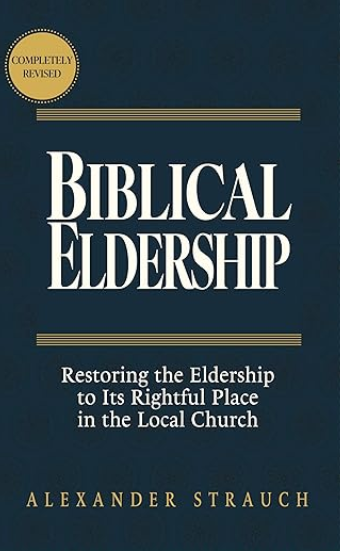
There is much more for those interested to learn about Eldership. The Bible will be our guiding text for the practice of Eldership and everything else. However, there is an excellent book that is an exhaustive study of the scriptures on Eldership. It is ‘Biblical Eldership - An Urgent Call to Restore Biblical Church Leadership’ by Alexander Strauch. We will ask anyone interested in becoming an Elder to read the full book. We will ask all members to read the shorter ‘booklet’ form to understand our leadership structure and process.
Deacons
Alexander Strauch authored another exhaustive bible study on the role of deacons titled ‘Paul’s Vision for the Deacons - Assisting the Elders with the Care of God’s Church’. The Greek word ‘diakonos’ is translated as ‘Deacon’ or ‘servant’ depending on the context. The former refers to the official church office, while the latter can refer to any servant of the church as well as servants in general. It can also correctly be translated as ‘assistant’.
The first Deacons (though they are not yet called Deacons) were appointed in Acts 6:1-5 to assist the Elders by taking charge of assistance to widows in the church.
I Timothy 3:8-13 lists the qualifications for Deacons.
Our Deacons will take the lead in ministering to physical needs as they arise and will assist the Elders in any other way they require. It’s important to note that the character requirements for Deacons are basically the same as that of Elders. It’s an important role and can also be a great start for those interested in being Elders in the future.
It is not clear from scripture if the office of Deacons should be open to women. I Timothy 3:11 uses a word that can be translated as ‘wives’ or ‘women’. Additionally, some translations show the female Phoebe as a ‘Deacon’ and others ‘servant’ (Romans 16:1).
Strauch handles five different interpretations on the issue exhaustively. He favors the male-only and makes a good argument for it but concedes it has weaknesses. I read his 35 page document on the issue and struggled with it in diligent prayer.
This is subject to change (as anything on this document is) as we remain open-minded to how the Spirit leads. However for now, we will recognize women as Deacons with two minor, common-sense caveats:
Elders should handle any disciplinary/authority issues directly and not include any uninvolved female Deacon in order to simply assist him.
Elders should not spend alone time with female Deacons assisting them. Meetings, when necessary, can be handled via phone, video conference or in a public setting.
Conclusion
If you’ve read this far, congratulations and thank you! You must have some interest.
If you are beginning to believe that recovering these New Testament principles and practices offers a pathway toward restoring the church's biblical character and effectiveness in fulfilling its mission or you have questions, please reach out. I’d love to hear from you!
Originally published [11/19/26], last updated [11/19/26]